At Echoshopbd, we’ve helped hundreds of people build better workspaces — and the number one complaint we hear isn’t about the desk or the shelves. It’s the chair. Specifically: “I can’t find the best ergonomic chair that doesn’t eat up half my room.” We get it. And we’ve spent years figuring out what actually works for tight spaces without destroying your spine in the process.
This isn’t a list of specs copied from a product manual. This is what I’d tell a friend who called me from the furniture shop, confused and overwhelmed.
The real problem with Best Ergonomic Chair in small rooms
Here’s the thing — most ergonomic office chairs were designed for corporate boardrooms. They’re wide. They have massive headrests that stick up and make a small room feel like a waiting room. They push out 70 cm from the wall when reclined. In a 10 x 12 ft room, that’s not a chair. That’s a roommate.
The phrase “ergonomic desk chair for small spaces” gets thrown around a lot, but genuinely few chairs deliver on both halves of that promise. Either the chair is compact but has no lumbar support, or it has proper ergonomics but is the size of a small vehicle.
You need to know what to prioritise — and what you can safely skip.

What “ergonomic” actually means — and what the industry lies about
Ergonomic is one of those words that’s been so heavily marketed it’s almost meaningless now. So let me be direct.
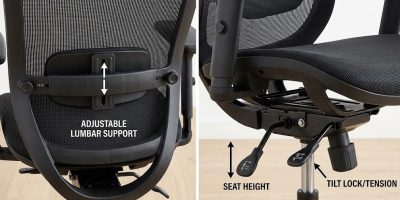
A genuinely ergonomic chair does three things well: it supports the natural S-curve of your spine, it lets you adjust seat height so your feet sit flat on the floor, and it keeps your hips at roughly 90–110 degrees. That’s it. Everything else — the mesh back panels, the tilt-lock mechanisms, the adjustable armrests — those are features, not requirements.
Plenty of budget chairs tick all three boxes. Plenty of expensive chairs miss them entirely because they’re designed to look impressive on a spec sheet.
The specs that matter for small spaces specifically
- Seat width under 50 cm. Most standard ergonomic chairs run 52–58 cm wide. A 48–50 cm seat fits most adults comfortably and takes meaningfully less footprint.
- Chair depth 45–50 cm. This is the front-to-back seat measurement. Too deep and you can’t sit back properly; your lower back hangs in the air. Too shallow and your thighs aren’t supported. Most people get this wrong.
- Back height under 90 cm total. Skip the giant headrest if your ceilings are low or shelves are nearby. A mid-back chair that hits your shoulder blades is genuinely sufficient for most people who don’t have neck issues.
- Compact base diameter. The five-star base on most chairs extends 65–70 cm in diameter. Look for chairs with a tighter base — around 58–62 cm — and you’ll reclaim real floor space.
The parts of a chair nobody talks about — but should
When we’re sourcing chairs at Echoshopbd, I always check three things that never appear on product pages. These are the things that tell me within about two minutes whether a chair is built to last or built to look good in photos.
The foam density question
Seat cushion foam is rated by density — kilograms per cubic metre. Under 30 kg/m³ and you’ll feel the chair “bottom out” within six months. The foam compresses and never fully recovers. Good chairs use 40–50 kg/m³ high-resilience foam. You can’t see this on a product listing, so ask. If the seller doesn’t know, that’s already your answer.
I’ve seen chairs marketed at serious prices with foam so light it felt like sitting on a sponge. And I’ve seen mid-range chairs with proper high-density foam that still felt great after three years of daily use. Density is everything.
The gas lift test
When you sit on a chair and adjust the height, there should be a smooth, controlled hiss. Not a loud clunk. Not a sudden drop. A clean, progressive movement. Cheap gas cylinders have inconsistent pressure — they drop too fast, or they don’t hold position under body weight and slowly sink through the day. If you’ve ever found yourself sitting lower at 4 PM than you were at 9 AM, that’s a failing gas lift. Not a feature. A defect.
The frame knock test
Knock firmly on the back frame of a chair — the upright part, not the cushion. A solid knock with a dull thud means steel or thick aluminium. A hollow, slightly tinny sound means thin steel tube or plastic-reinforced frame. The latter is fine for occasional use. For 8 hours a day, you want the former.
One test we run on every chair before we approve it for our catalog: we put 90 kg of static load on the seat for 72 hours, then check whether the foam has recovered to within 5% of its original height within 24 hours. Most people don’t think about this. But a chair that can’t recover its shape after a sustained load will start to feel “dead” inside of a year. We’ve rejected chairs from otherwise reputable manufacturers because they failed this basic test. It’s not dramatic — it just quietly ruins your posture over time.
Armrests in small spaces: use them right or ditch them
Fixed armrests on a small-space chair are, honestly, more trouble than they’re worth. If they’re not at exactly the right height for you, they either push your elbows up and tense your shoulders, or they’re so low you ignore them entirely. Meanwhile, they add width and prevent the chair from sliding fully under your desk.
What works: 2D or 4D adjustable armrests that can flip up when not in use, or no armrests at all. A lot of people find that working without armrests forces better shoulder posture — you stop hunching, because you have nothing to lean on awkwardly. It sounds counterintuitive, but it’s true for many.
If you do want armrests, check that the inner width between them is at least 42 cm so you can actually use the chair comfortably, and that they fully clear the underside of your desk at their lowest point.
Mesh vs. foam backs: the honest answer for humid climates
This matters more than most guides admit. Foam-back chairs hold heat. If you’re working in a room that gets warm — and in Bangladesh, that’s most rooms for most of the year — a foam back means a sweaty back within an hour. Mesh breathes. Significantly.
That said, not all mesh is the same. Cheap mesh stretches and sags within a year, offering no real support. Good mesh — like the kind used in quality mid-backs — is tensioned and woven tightly enough to distribute load without deforming. Press your hand firmly into the back of any mesh chair you’re considering. If it immediately stretches more than 2–3 cm under moderate pressure, that tension is already low and it’ll only get worse.
For our climate, I’d always lean toward mesh. But I’d rather have a well-made foam-back chair than a poorly made mesh one.

A fix for the most common small-chair problem — the creaking squeak
Chairs squeak. Almost all of them do, eventually. Here’s the thing most people don’t know: the squeak is almost never from where you think it is.
People assume it’s the gas lift, so they spray WD-40 on it. It doesn’t help, because the squeak is usually from the tilt mechanism — specifically, the small metal plates inside the seat plate assembly rubbing against each other. Pull the seat off if possible, and apply a small amount of lithium grease (not WD-40 — that evaporates within weeks) directly to the contact points of the tilt mechanism. Reassemble and test. Nine times out of ten, silence.
If the squeak is definitely from the base wheels, the fix is easier: a few drops of 3-in-1 oil on the wheel axle. Takes thirty seconds.
Before you buy: your 8-point checklist
Run through this. It’ll take two minutes and save you months of regret.