It’s easy to fall for a big, plush three-seater in a showroom. Then it arrives, and you’re turning sideways to reach the window.
The best furniture for small living rooms on a budget is rarely the cheapest piece or the prettiest one. It’s furniture sized for your room, useful in more than one way, and sturdy enough that you won’t be replacing it in a couple of years. This guide covers what to buy first, how to compare your options, and which mistakes cost the most.

Quick Answer: What to Buy First
If your budget only stretches to a few pieces, start with these:
- A compact sofa or loveseat with slim arms and visible legs
- A storage ottoman or nesting tables to cover seating, a surface, and storage
- Wall shelves or a tall, narrow bookcase to use vertical space
- A light-colored rug to anchor the seating area
Everything else can wait. Get the layout working first, then add pieces one at a time.
Measure Before You Shop
Most budget regrets come from furniture that was the wrong size, so measure first.
- Measure the room’s length and width, and note where doors, windows, sockets, and radiators or AC units sit.
- Leave roughly 80-90 cm (about 3 feet) for main walkways. This is a common comfort guideline, not a strict rule. A tight side path of 60 cm or so can be fine if you rarely use it.
- Measure the doorway, hallway, and stairwell or lift the furniture has to pass through.
- Mark the furniture’s footprint on the floor with masking tape or newspaper and leave it for a day. If you keep stepping around it, it’s probably too big.
As an example, a 10 by 12 foot room might feel cramped with a 7-foot sofa and two armchairs. A smaller sofa and a single accent chair would leave more floor open. Your room’s shape and door placement matter as much as its size.
how to choose a sofa for a small living room
Furniture Options and Their Trade-offs
Compact Sofa vs. Loveseat
Both work in small rooms, but they suit different households.
A loveseat takes the least space and usually costs less than a full-size sofa, though that depends on the brand and materials. It seats two comfortably, so add a pouf or stool for guests.
A compact (apartment-size) sofa seats three at a tighter size. It costs more than a loveseat in most cases, but it works better if you often have three people sitting together.
Whichever you choose, a few features help in a small room:
- Slim, low arms use less of the room’s width.
- Raised legs let you see the floor underneath, which can make the space feel more open.
- A shallower seat depth saves floor space, but check comfort by sitting in it. Very shallow seats can feel awkward for taller people.
- Light or neutral upholstery tends to look less heavy than very dark, bulky fabric.
Sofa Bed or Daybed
A sofa bed helps if the living room doubles as a guest room. The trade-off is that budget fold-out mechanisms can feel stiff and may wear faster, and the mattress is often thinner than a regular one. Test the mechanism in person, and check how much clearance you need to open it.
A simple daybed can be a sturdier alternative if you only need occasional sleeping space. It works less well as a main sofa because the back support is minimal.
Skip it if: the sofa will be your main everyday seat and you want maximum comfort.
Best Furniture: Nesting Tables
A large coffee table can block the walkway in a small room. Nesting tables stay tucked together day to day and spread out when you have guests. A round or oval table is another option, since the lack of corners makes it easier to move around.
The downside is that nesting tables have smaller surfaces. If you often use the table for laptops, meals, or board games, a single sturdy table or storage ottoman with a tray may suit you better.
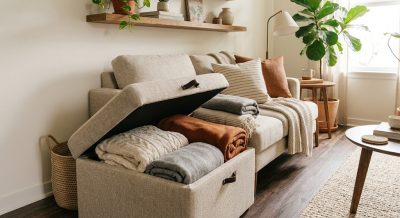
Storage Ottoman
An ottoman can serve as a footrest, extra seat, and hidden storage for blankets or kids’ toys. With a tray on top, it also works as a coffee table. Check how it holds weight if people will sit on it, and whether the lid opens fully without hitting the sofa.
It’s not the best choice if you need a firm surface for work or dining, as a padded top can be wobbly.
Wall Shelves and Narrow Storage
When floor space runs out, use the walls. Wall shelves take almost no floor space, and a tall, narrow bookcase usually costs you less room than a wide, low cabinet. Check your wall type first, since hollow or brittle walls may need specific anchors and weight limits apply.
Slim TV Unit
Bulky TV cabinets use up a lot of room. A slim console or a wall-mounted TV with a floating shelf below can free up more space. Wall mounting needs a suitable wall and proper installation, so it won’t suit every rental.
Stackable or Foldable Seating
Folding chairs and stackable stools aren’t glamorous, but they’re useful if you host only occasionally. They store behind a door or in a corner until needed.
Which Materials Work on a Budget?
Material affects both price and durability, but construction quality, finish, and how much moisture the furniture sees matter just as much as the material itself.
| Material | Typical Cost Position | Moisture Behavior | Good For | Watch Out For |
|---|---|---|---|---|
| Solid wood | Often higher, varies by species | Can expand, shrink, or warp with humidity changes; a good finish helps | Long-lasting main pieces | Higher price; heavier to move |
| Plywood | Often mid-range | Often handles moisture better than MDF, but quality and glue type vary; exposed edges can still absorb water | Shelves, TV units, storage | Cheap grades may have gaps or weak layers |
| MDF | Often among the lowest | Can swell if water gets into unsealed edges or damaged surfaces | Dry rooms, light-use pieces | Edge damage; may hold screws less well after repeated assembly |
| Metal | Varies widely | Depends on the metal and coating; powder-coated or galvanized finishes resist rust better than thin paint | Shelves, frames, stools | Cheap coatings can chip and rust |
Prices vary by location, brand, and seller, so compare a few before deciding. In humid or rainy climates, keep wooden pieces slightly away from damp walls, wipe up spills quickly, and make sure the room gets some airflow.

Layout Tips for a Small Living Room
Good furniture still needs a layout that works for it.
- Place the largest piece, usually the sofa, against a wall, and try not to block windows or main walkways.
- Use one larger rug rather than several small ones, so the seating area looks connected.
- Mirrors opposite a window can reflect light and make a room feel brighter, though they won’t change the room’s actual size.
- Hanging curtains higher than the window frame can make the window look taller. This is a visual trick, not a fix for a dark room.
- Keep your color palette limited, since fewer colors can make a small room feel less busy.
Where to Spend and Where to Save
If money is limited, put it where the use is heaviest.
Spend more on:
- The sofa, since it gets daily use and the frame, cushion fill, and upholstery all affect how long it lasts
- Any piece with moving parts, such as a sofa bed or recliner
Save on:
- Side tables and nesting tables
- Wall shelves and simple storage
- Cushions, rugs, and décor
Second-hand furniture can be a good way to stretch a budget, especially solid wood, which can often be refinished. Inspect pieces in person, wobble the joints, check legs and corners for cracks, and look for signs of termites or damp before paying.
Common Mistakes to Avoid
- Buying a matching set by default. Sets can look neat in shops but may overwhelm a small room. Buying individual pieces gives you more control over size.
- Choosing a style that doesn’t suit daily use. A small chair that looks great but isn’t comfortable for more than ten minutes will mostly sit unused.
- Ignoring delivery access. Furniture that doesn’t fit through the door, stairwell, or lift is a costly mistake. Measure the route first.
- Spending the whole budget at once. Living in the room for a few weeks often shows what you actually need.
FAQ
What furniture do you really need in a small living room?
A sofa or loveseat, one flexible table or ottoman, and some storage cover most needs. Add other pieces only if you can still move around comfortably.
How can I make a small living room look bigger on a budget?
Choose furniture with visible legs, keep colors light and limited, use one larger rug, and add a mirror opposite a window. Keep floor clutter low, since open floor space tends to make a room feel larger.
Is a sectional sofa a good idea for a small living room?
It can work if a small L-shaped sofa fits a corner well, but a large sectional can dominate the room. Measure carefully and check that walkways stay clear.
Is MDF furniture okay on a tight budget?
It can work for dry, light-use pieces like decorative shelves. Moisture is its main weakness, so in humid areas or places with spills, plywood or solid wood may last longer, depending on quality and finish.
Should I buy second-hand furniture for a small living room?
It can save money, especially on solid wood pieces. Inspect it in person, test the joints, and check for termite damage or a damp smell before buying.
Final Thoughts
The best furniture for small living rooms on a budget fits your space, does more than one job, and leaves room to walk. Measure first, choose a compact sofa or loveseat that suits how many people usually sit, and add flexible pieces like nesting tables or a storage ottoman. Buy gradually, spend most on what you use daily, and use the walls for storage.