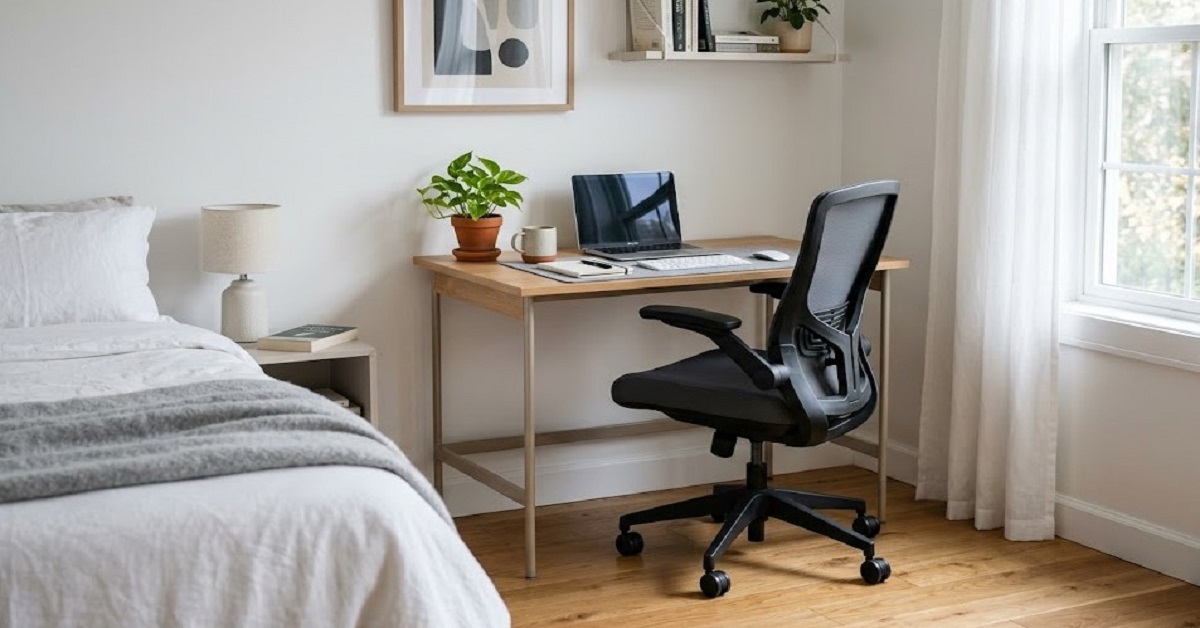
Ergonomic Desk Chairs for Small Spaces. Because most “ergonomic” chairs are designed for corner offices — not the 8×10 room you’re working from home in. By the Echoshopbd Team · 10 min read · Updated April 2026.
Your back’s been aching since Tuesday. You look over your shoulder and the chair arm has gouged a mark into your bed frame — again. You’ve been meaning to fix this for months, and you keep putting it off because finding an ergonomic desk chair that actually fits a small bedroom or studio apartment feels nearly impossible.
I get it. At Echoshopbd, we’ve been helping customers furnish compact workspaces for years, and this is genuinely one of the hardest furniture problems to solve well. The ergonomics industry is built around spacious corporate offices. Most chairs are designed with no thought to how they’ll live in a 3-metre-wide room. That’s the gap I want to close here.
Let me walk you through what I’ve learned — from showroom floors, from customers who’ve returned chairs that didn’t work, and from physically sitting in more desk chairs than any sane person should.
Why “Ergonomic” Alone Doesn’t Mean Right for Small Spaces
Here’s the thing: a chair can be genuinely ergonomic and still be completely wrong for your room. The two problems are separate. Ergonomics is about how the chair supports your body. Space-compatibility is about how the chair behaves in your room — its footprint, its armrest clearance, how far it rolls, how it looks against a wall two feet away.
Most buyers don’t realize that the industry-standard “big ergonomic chair” — think of those wide mesh behemoths — has an average seat depth of 52–55 cm and a total width of 68–72 cm with armrests extended. In a small room, that thing owns the space. It hits your desk, it hits your bed, and every time you push back to stand up, you’re doing a little obstacle course.
What you actually need is a chair that gives you real lumbar support, adjustable seat depth, and proper height range — but does all of that in a 55 cm-wide footprint or less. Those chairs exist. You just have to know what to look for.
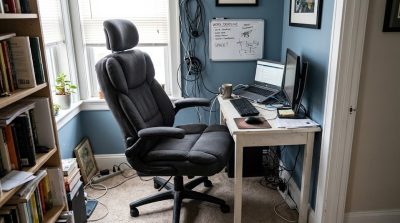
The Measurements That Actually Matter for Ergonomic Desk Chairs in Small Spaces
I want to give you numbers, because vague advice is useless when you’re buying furniture online.
Seat Width — The One Everyone Ignores: Ergonomic Desk Chairs for Small Spaces
For a small-space chair, look for a seat width of 46–52 cm. That’s not the full chair width — that’s just the seat pan. A narrower seat pan lets the armrests (if any) tuck closer and the overall silhouette stay compact. Anything over 54 cm seat width starts to crowd a small desk setup.
Seat Depth Adjustment — Ergonomic Desk Chairs for Small Spaces
Seat depth should ideally adjust between 40–50 cm. Here’s why this matters for smaller rooms: a shallower seat means you sit closer to your desk naturally, which means you don’t push the chair back as far when you stand. Over the course of a day, that’s a lot of saved centimetres between you and your wall.
Gas Lift Range — Ergonomic Desk Chairs for Small Spaces
The standard gas lift range on most chairs is 42–52 cm from floor to seat. That’s fine for people 170–185 cm tall. If you’re shorter, you need a chair with a low-range lift that goes down to 38–40 cm. Sitting too high — feet dangling, thighs unsupported — is one of the fastest ways to develop hip flexor tension. It also means you’re constantly adjusting, rolling around, taking up more floor space.
- Armrest width clearance: Look for armrests that fold up or fully detach — that alone saves 8–12 cm per side when you’re tucking the chair under the desk
- Backrest height: Mid-back chairs (60–70 cm backrest height) often fit better under low shelves or lofted beds than full-back tall chairs
- Base diameter: Standard is 68 cm. Some compact chairs go to 60 cm — meaningfully smaller on a rug or in a tight corner
- Tilt tension: Should be adjustable by weight — a lightweight person needs low tension to recline without straining, a heavier person needs more resistance to avoid tipping back unexpectedly
We had a customer at Echoshopbd — a graphic designer working from a studio apartment — who came back after buying a “petite” ergonomic chair online. The seat pan was narrow, yes. But the five-star base spread to 70 cm. In her room, that base overlapped the legs of her desk every time she pulled in close. She was constantly knocking it. The lesson: measure the base spread, not just the seat. It’s almost always the widest point on the whole chair, and almost nobody lists it prominently in spec sheets. Ask for it.
Lumbar Support in a Compact Chair — Ergonomic Desk Chairs for Small Spaces
Bad lumbar support is everywhere. You know it when you feel it — that aggressive, fixed plastic bump that hits you mid-spine and makes you slouch away from it within an hour. Real lumbar support should feel like a gentle, consistent pressure in your lower back curve, not a poke.
For a small-space chair, I lean toward chairs with built-in adjustable lumbar (height-adjustable, not just depth). External lumbar pillows are popular, but they add 5–8 cm of depth to the chair, which pushes you further from your desk. When you’re already tight on space, that’s not ideal.
The foam density of the seat itself matters too. A good task chair seat uses high-resilience (HR) foam in the 35–45 kg/m³ range. Sit on anything softer and you’re sinking into the base in two months. You can’t feel this by looking at photos — but you can often tell by weight. A chair with quality foam construction will feel denser when you lift it. Flimsy-feeling chairs that are suspiciously light usually have cheap, low-density foam that’ll flatten out fast.
The Gas Lift — Ergonomic Desk Chairs for Small Spaces
I know this sounds strange, but: listen to the gas lift when you adjust the height. A quality gas lift — one that will last 5–7 years of daily use — has a smooth, controlled descent and a click-lock that’s clean and decisive. You barely need to press the paddle.
A cheap gas lift feels loose. It hisses slightly. The seat sometimes drifts down slowly on its own after you release the lever. If you’re testing in a showroom, press the lever and release without sitting — a good lift holds position cleanly. A bad one creeps.
For small-space use, gas lift quality matters even more because you’re adjusting your chair more often — tucking it under the desk, pulling it out, working in different positions. A lift that fails in year two is a real problem.
If you want to test a chair’s gas lift quality at home (after delivery), try this: sit in the chair, adjust to your working height, then stand up and remove all weight completely. Watch the seat. Over 30 seconds, it should not drop even a millimetre. If it drifts down 1–2 cm without any weight on it, the cylinder seal is already compromised or was poorly made. That chair’s lift is on borrowed time, and most manufacturers won’t honour a warranty claim on gas cylinder drift unless it’s dramatic. Catch it early and request a replacement within the return window.

Mesh vs. Foam Seat: Ergonomic Desk Chairs for Small Spaces
This debate goes on forever online. Here’s my honest take after years of handling both:
Full mesh chairs — where both the seat and back are mesh — tend to have a larger visual and physical presence. The seat mesh needs a deep, structural frame to hold tension correctly, and that frame adds width. They’re also harder to keep clean if your room is dusty (and small rooms collect dust fast — trust me on this).
For small spaces, I generally prefer a foam seat with a mesh back. You get the breathability where you need it most — behind your back during long sitting sessions — while the foam seat allows for a slimmer, more compact seat frame. The total chair footprint tends to be smaller, and the silhouette sits more quietly in a room.
That said, if you run hot and sweat through foam cushions, full mesh is genuinely worth the trade-off. Just measure twice before buying.
- Foam seat + mesh back: Smaller footprint, easier to clean, better for compact rooms
- Full mesh: Better breathability all-round, but usually wider frame and more visual bulk
- Full foam/upholstered: Best for short sessions — gets uncomfortable fast for 6+ hour workdays, and often the heaviest option
What to Avoid — 4 Common Mistakes When Buying for Small Spaces
- Buying by aesthetics first. That sleek-looking gaming chair might photograph beautifully, but gaming chairs have bucket-style seats (deep, curved sides) that force your pelvis into a posterior tilt. For desk work, that’s posture suicide. Always check whether it’s built for sitting upright, not reclined gaming.
- Ignoring the return policy. You cannot truly know if a chair works for your body until you’ve sat in it for two hours. If the retailer offers less than a 14-day return window, that’s a flag. Good furniture retailers — including us at Echoshopbd — stand behind their products with real return policies, not asterisks.
- Skipping the armrest test. Fixed armrests are the enemy of small spaces. If the armrests don’t flip up or detach, you can’t push the chair fully under the desk when it’s not in use. That’s real estate you’re losing every time you leave the desk.
- Trusting “petite” or “small” labels without checking specs. Those labels aren’t standardised anywhere. I’ve seen “compact” chairs with a 72 cm base spread. Always verify seat width, base diameter, and seat depth in the actual product specs — or ask before buying.
A Few Chairs Worth Considering (And Why)
I’m not going to name fifteen options and overwhelm you. Here’s the honest shortlist of what I’d look for in each price tier, based on what we see work for real customers:
Budget tier (under ৳12,000): Focus on adjustable lumbar and a flip-up armrest. Don’t expect the gas lift to last more than 3 years of heavy use, but you can replace a cylinder cheaply. Avoid full mesh at this price — the tension loosens quickly.
Mid tier (৳12,000–৳28,000): This is where the real value lives for small spaces. You’re getting proper HR foam or quality mesh, a 4D armrest that tucks close, and a gas lift rated for 5+ years. Look for seat depth adjustment as a minimum.
Premium tier (৳28,000+): At this level, you’re getting precision engineering. Chairs like these have lumbar depth adjustment (not just height), dynamic backrests that move with you, and base spreads as tight as 58 cm on compact models. Worth it if you’re sitting 8+ hours a day.
Before You Buy: Your Checklist
Run through this before confirming the order. Five minutes now saves a return headache later.
- Seat width is 46–52 cm (measure, don’t trust the label)
- Base spread is 68 cm or less — ideally 60–65 cm for tight rooms
- Seat height range goes low enough for your height (check: seat height min should be ≤ your knee height when seated)
- Armrests flip up or fully detach — fixed armrests are a deal-breaker for small spaces
- Lumbar support is height-adjustable, not fixed
- Gas lift tested (or confirmed by reviews) to hold position without creeping down
- Seat depth is adjustable or is ≤ 47 cm fixed
- Chair weight is over 10 kg — lightweight usually means cheap foam and thin frame
- Return window is 14 days minimum with no-questions policy
- You’ve measured your floor space and confirmed the chair can fully tuck under your desk with armrests up